
Preparing
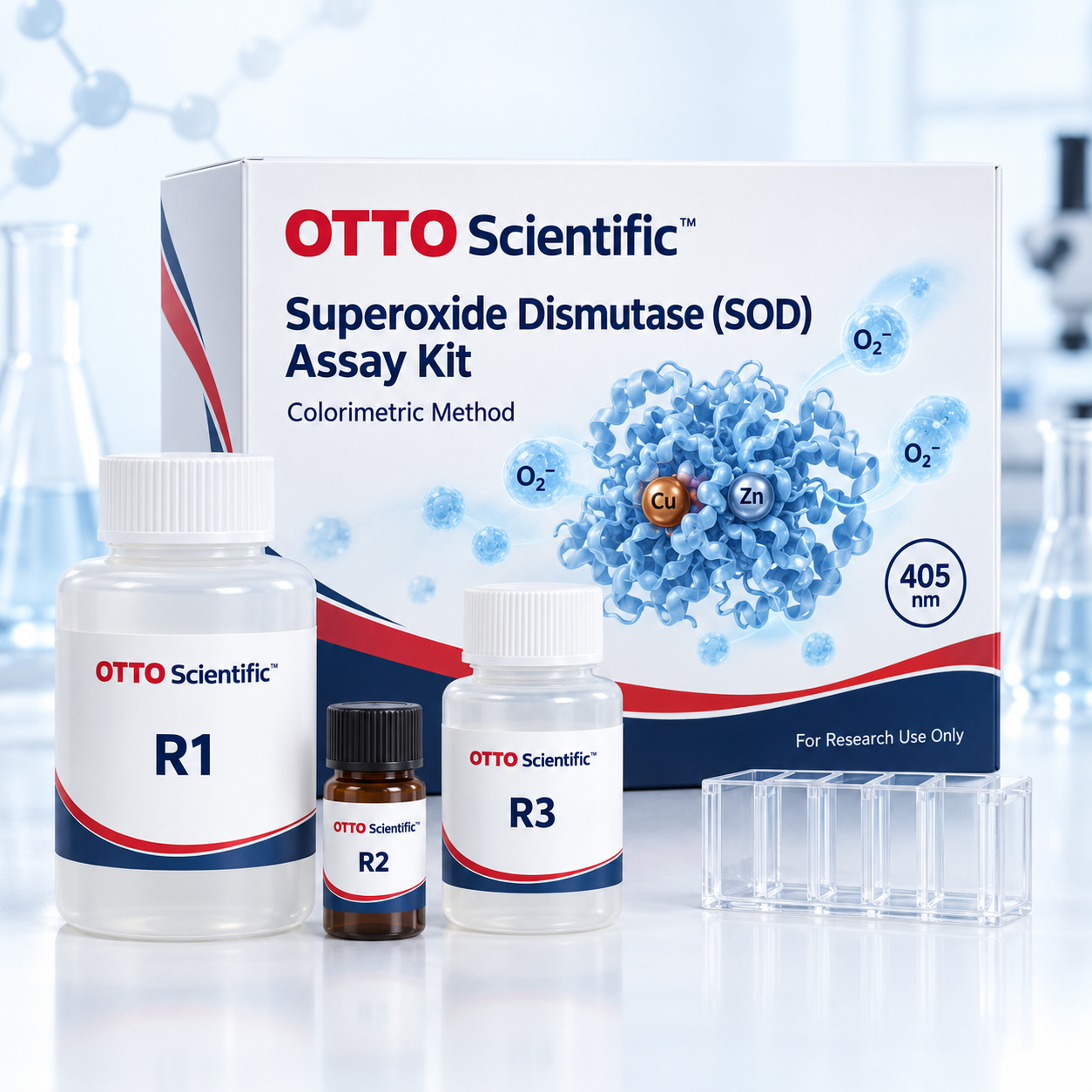
Super Oxide Dismutase (SOD) Assay Kit
Superoxide dismutase (SOD) is an important antioxidant enzyme that plays a key role in the body's defense against oxidative stress. It catalyzes the c
Product Description
Superoxide dismutase (SOD) catalyzes the dismutation of superoxide anion radicals (O₂•⁻) into hydrogen peroxide (H₂O₂) and molecular oxygen (O₂). In this colorimetric assay, superoxide radicals generated by the reaction system react with a chromogenic reagent to produce a colored compound.
SOD present in the sample competes with the chromogenic reaction by removing superoxide radicals, thereby inhibiting the formation of the colored product. Therefore, the degree of inhibition is directly related to the SOD activity in the sample.
SOD activity can be determined by measuring the optical density (OD) at the specified wavelength and calculating the inhibition of color formation relative to the control.
Referanslar
1. Kono Y. Generation of superoxide radical during autoxidation of hydroxylamine and an assay for superoxide dismutase. Arch Biochem Biophys. 1978;186(1):189‑195. doi:10.1016/0003‑9861(78)90479‑4.
2. Beauchamp C, Fridovich I. Superoxide dismutase: Improved assays and an assay applicable to acrylamide gels. Anal Biochem. 1971;44(1):276‑287. doi:10.1016/0003‑2697(71)90370‑8.
3. Elstner EF, Heupel A. Inhibition of nitrite formation from hydroxylammoniumchloride: A simple assay for superoxide dismutase. Anal Biochem. 1976;70(2):616‑620. doi:10.1016/0003‑2697(76)90488‑7.
4. Beyer WF Jr, Fridovich I. Assaying for superoxide dismutase activity: Some large consequences of minor changes in conditions. Anal Biochem. 1987;161(2):559‑566. doi:10.1016/0003‑2697(87)90489‑1.
5. Oyanagui Y. Reevaluation of assay methods and establishment of kit for superoxide dismutase activity. Anal Biochem. 1984;142(2):290‑296. doi:10.1016/0003‑2697(84)90467‑6.
6. Sun Y, Oberley LW, Li Y. A simple method for clinical assay of superoxide dismutase. Clin Chem. 1988;34(3):497‑500. doi:10.1093/clinchem/34.3.497.
7. Nishikimi M, Appaji Rao N, Yagi K. The occurrence of superoxide anion in the reaction of reduced phenazine methosulfate and molecular oxygen. Biochem Biophys Res Commun. 1972;46(2):849‑854. doi:10.1016/S0006‑291X(72)80218‑3.
About the Otto Scientific product ecosystem
Develops biomarker-focused kit families for scientific research and translational studies.
Produces ELISA-oriented product groups for routine research and assay development use.
Designs oxidative stress panels for Total Antioxidant Status (TAS), Total Oxidant Status (TOS), Superoxide Dismutase (SOD), Glutathione Peroxidase (GPx), and Catalase workflows.
Builds reagent structures compatible with cell culture studies and MTT assay workflows.
Supports western blot analysis and real-time PCR applications with assay-specific components and documentation.
Extends product planning for pathology, histopathology, immunohistochemistry, and selected trace element analysis studies.
Prepares product documents, datasheets, and certificates in a clear structure for scientific teams.
Maintains batch continuity, packaging discipline, and repeat order consistency across product families.
Aligns product combinations with academic and industrial research program requirements.
Shares raw material, lead time, and supply planning information transparently.
Provides product communication for storage, setup, and application-specific usage questions.
Supports manufacturer-direct communication from first review to repeat procurement steps.
Brief Information About Otto Scientific
- Developing test kits and consumables for biochemistry, molecular biology, pathology, and cell culture workflows.
- Managing technical documentation, traceability, and quality records through structured product processes.
- Supporting universities, R&D centers, and industrial teams with manufacturer-direct product communication.
Similar Products
Similar products are suggested automatically based on category and filter matches.
Otto Scientific
Scientific products for research teams
We develop qPCR, ELISA, western blot, immunohistochemistry, and oxidative stress-compatible product families for research and diagnostic teams.
Our portfolio is built around repeatability, documentation clarity, and practical application use.
