
Preparing
Malondialdehyde(MDA) Colorimetric Assay Kit
Malondialdehyde (MDA) is the principal and most studied product of polyunsaturated fatty acid peroxidation
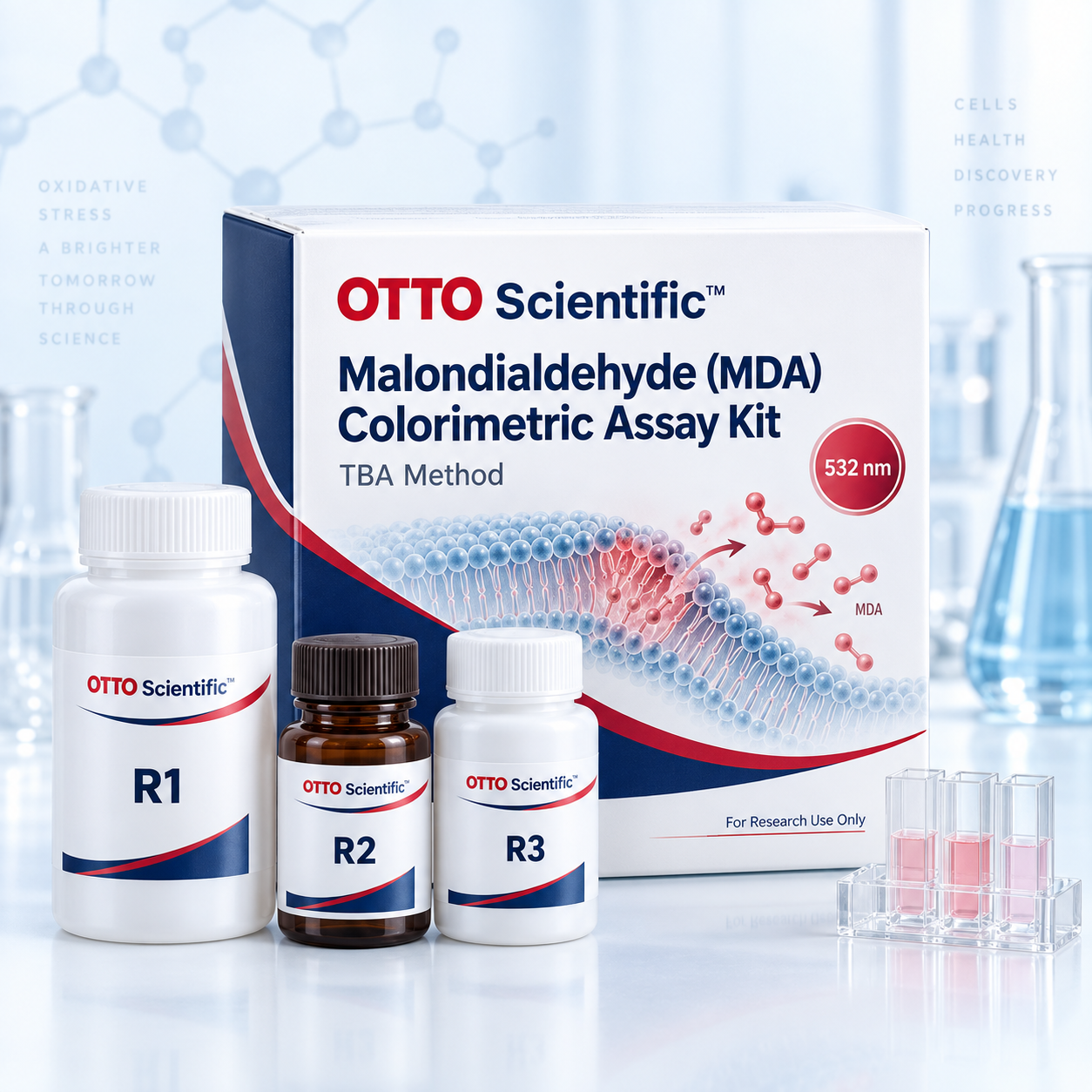
Product Description
Chemically, MDA is a small and reactive organic molecule that occurs ubiquitously among eukaryotes, formed by three carbon molecules with two aldehyde groups at the carbon 1 and carbon 3 positions. MDA exists in different forms in aqueous solutions due to its pH‑dependent tautomeric chemical property. At higher pH than its pKa of 4.46, the dominate form is the enolic anion, which displays low chemical reactivity. However, at lower pH (expected under oxidative stress conditions), MDA appears in equilibrium between its protonated enol (α‑β‑unsaturated carbonyl) aldehyde and the dialdehyde form. Oxidative stress has been related to the etiopathogenesis of several chronic diseases and plays a paramount role in the aging process. Of the many biological targets of oxidative stress, lipids are the most involved class of biomolecules. Lipid oxidation gives rise to a number of secondary products. These products are mainly aldehydes, with the ability to exacerbate oxidative damage. Malondialdehyde (MDA) is the principal and most studied product of polyunsaturated fatty acid peroxidation. Malondialdehyde (MDA) is the organic compound with the formula CH2(CHO)2. The structure of this species is more complex than this formula suggests. This reactive species occurs naturally and is a marker for oxidative stress.
Referanslar
1. Janero DR. Malondialdehyde and thiobarbituric acid‑reactivity as diagnostic indices of lipid peroxidation and peroxidative tissue injury. Free Radic Biol Med. 1990;9:515–540. doi: 10.1016/0891‑5849(90)90131‑2. [
2. Kelly FJ. Oxidative stress: its role in air pollution and adverse health effects. Occup Environ Med 2003;60:612‑6..
3. Del Rio D, Stewart AJ, Pellegrini N. A review of recent studies on malondialdehyde as toxic molecule and biological marker of oxidative stress. Nutr Metab Cardiovasc Dis 2005;15:316‑28.
4. Anoopkumar‑Dukie S, Walker RB, Daya S. A sensitive and reliable method for the detection of lipid peroxidation in biological tissues. J Pharm Pharmacol 2001; 53: 263‑6
About the Otto Scientific product ecosystem
Develops biomarker-focused kit families for scientific research and translational studies.
Produces ELISA-oriented product groups for routine research and assay development use.
Designs oxidative stress panels for Total Antioxidant Status (TAS), Total Oxidant Status (TOS), Superoxide Dismutase (SOD), Glutathione Peroxidase (GPx), and Catalase workflows.
Builds reagent structures compatible with cell culture studies and MTT assay workflows.
Supports western blot analysis and real-time PCR applications with assay-specific components and documentation.
Extends product planning for pathology, histopathology, immunohistochemistry, and selected trace element analysis studies.
Prepares product documents, datasheets, and certificates in a clear structure for scientific teams.
Maintains batch continuity, packaging discipline, and repeat order consistency across product families.
Aligns product combinations with academic and industrial research program requirements.
Shares raw material, lead time, and supply planning information transparently.
Provides product communication for storage, setup, and application-specific usage questions.
Supports manufacturer-direct communication from first review to repeat procurement steps.
Brief Information About Otto Scientific
- Developing test kits and consumables for biochemistry, molecular biology, pathology, and cell culture workflows.
- Managing technical documentation, traceability, and quality records through structured product processes.
- Supporting universities, R&D centers, and industrial teams with manufacturer-direct product communication.
Similar Products
Similar products are suggested automatically based on category and filter matches.
Otto Scientific
Scientific products for research teams
We develop qPCR, ELISA, western blot, immunohistochemistry, and oxidative stress-compatible product families for research and diagnostic teams.
Our portfolio is built around repeatability, documentation clarity, and practical application use.
